





TPC Staff
The Palestine Chronicle / August 13, 2026
A new report documents thousands of restrictions on Palestinian content, arguing Meta’s moderation systems have systematically undermined Palestinian visibility online.
‘Platformicide of Palestine’
Meta’s content moderation practices have systematically restricted Palestinian voices on Facebook and Instagram, according to a new report examining thousands of alleged digital rights violations over a five-year period.
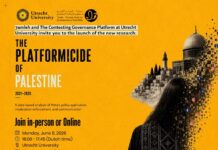
The Platformicide of Palestine 2021-2025, produced by Palestinian digital rights organization 7amleh and a researcher at Utrecht University, examined 3,520 cases submitted to 7amleh’s Palestinian Observatory for Digital Rights Violations between January 2021 and December 2025.
The documented cases included account suspensions, removal of posts, restrictions on livestreaming and measures reducing the distribution and visibility of Palestinian content.
The researchers use the term “platformicide” to describe what they characterize as the structural erosion of Palestinian visibility and participation across major social media platforms.
While the report does not conclude that Meta deliberately targeted individual Palestinian users for censorship, it argues that the scale, repetition, and patterns of enforcement cannot adequately be explained as isolated moderation mistakes or technical errors.
Only one-third linked to identifiable violations
According to the research, only 32.5 percent of documented cases involved an identifiable violation of Meta’s policies.
Among cases in which a reason for enforcement was provided, Meta’s Dangerous Organizations and Individuals policy accounted for 57.2 percent of restrictions.
The proportion was even higher among journalists, reaching 71.1 percent.
Meta’s Dangerous Organizations and Individuals policy is intended to restrict praise, support and representation of organizations and individuals the company classifies as dangerous.
The report, however, argues that its implementation has gone considerably further, affecting Palestinian journalists, media outlets, activists and civil society organizations reporting on Palestine and Israel’s war on Gaza.
This is particularly significant for journalists whose work necessarily requires reporting on Palestinian political organizations, armed groups and developments related to the war.
Suspensions and ‘shadow banning’
Account suspension was the most frequently documented enforcement measure, affecting approximately one-third of the cases analysed.
Researchers also identified restrictions that were considerably less visible to users, including reduced distribution of posts and filtering from recommendation systems.
Such practices are commonly described by social media users as “shadow banning” because accounts can remain operational while their content becomes substantially less visible to other users.
The report argues that these forms of reduced visibility can be particularly damaging because affected users may not receive clear notification that their reach has been restricted or understand why their audiences have declined.
Nearly half of appeals received no response
The study also raises concerns over Meta’s appeals process.
Of 2,828 appeals submitted by 7amleh on behalf of affected users, nearly half received no response from Meta, according to the report.
The findings suggest that Palestinians whose accounts or content are restricted can face significant difficulties obtaining explanations or challenging enforcement decisions.
Meta has previously said it has been working to improve the accuracy of its Arabic-language moderation systems, including routing content to reviewers familiar with relevant Arabic dialects and providing clearer explanations to users about moderation decisions.
The report nevertheless argues that the documented patterns point to structural problems requiring broader reforms rather than individual corrections.
It calls on Meta to commission an independent human rights audit, reform the implementation of its Dangerous Organizations and Individuals policy, improve its appeals mechanisms and establish stronger protections for journalistic and other public-interest content.
(TPC, 7amleh, Utrecht University)
